
Back to News
Fugitive Dust and Diesel Exhaust: Aligning Construction Practices with Air Quality Goals
While driving past a construction site, you may observe clouds of dust from earth-moving activities or black smoke billowing from heavy equipment. These tiny particles are much more than a nuisance; they present significant risks to human health and the environment. Known as fugitive dust and diesel exhaust, both forms of particulate matter can negatively impact workers and nearby communities. In the construction industry, effectively mitigating these airborne pollutants is key to supporting community growth while safeguarding human health and the environment.
At the core of this risk is particulate matter (PM), or particle pollution, which is a mixture of liquid droplets and solid particles that vary in size and become suspended in the air. Fugitive dust, often generated by earth-moving operations, agricultural tilling, and unpaved roads, consists of PM10 particles, which are 10 micrometers or smaller in diameter. Diesel exhaust, or diesel particulate matter (DPM), emits PM2.5 from heavy machinery. To put these sizes into perspective, human hair ranges in diameter from 50 to 70 micrometers.
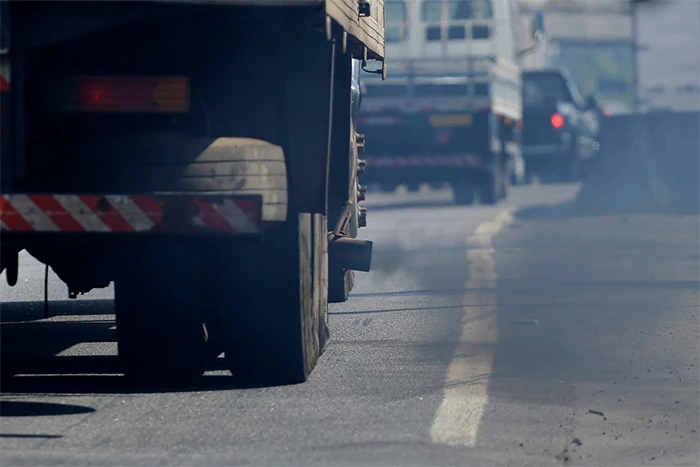
Because these particles are so small, they can penetrate your lungs and enter the bloodstream, causing respiratory issues and harming your cardiovascular system. Studies have shown exposure to be linked to various health problems, including nonfatal heart attacks, aggravated asthma, and decreased lung function. Diesel exhaust is particularly dangerous, as the World Health Organization’s International Agency for Research on Cancer (IARC) lists it as carcinogenic to humans. Beyond human health, these particles also degrade the surrounding environment in many ways, including depleting soil nutrients, damaging forests and crops, and contributing to acid rain.
The impacts of this pollution are severe enough that the Environmental Protection Agency (EPA) strictly regulates particulate matter as one of the six criteria pollutants under the Clean Air Act (CAA). These pollutants are used to set the National Ambient Air Quality Standards (NAAQS) to protect public health and prevent property damage. Residents living near major development projects are increasingly encouraged to monitor their local air quality through AirNow. This official U.S. government website lets users look up air quality in real time using the U.S. Air Quality Index (AQI). The AQI has six categories ranging from good to hazardous, each corresponding to different levels of health concern.
Despite regulations, uncontrolled emissions persist in construction zones. As someone living in Arizona, where dust and sand are a natural part of the landscape, I frequently witness fugitive dust migrating across the highway as I drive. Recently, a large economic development project, a proposed data center campus in Tucson, has made headlines for the amount of fugitive dust being generated at the site. The county's Department of Environmental Quality issued a notice of violation to the construction company after failing to implement adequate dust-control measures at the site. These violations cause community outrage, project delays, and can result in fines up to $10,000 per day, per violation.
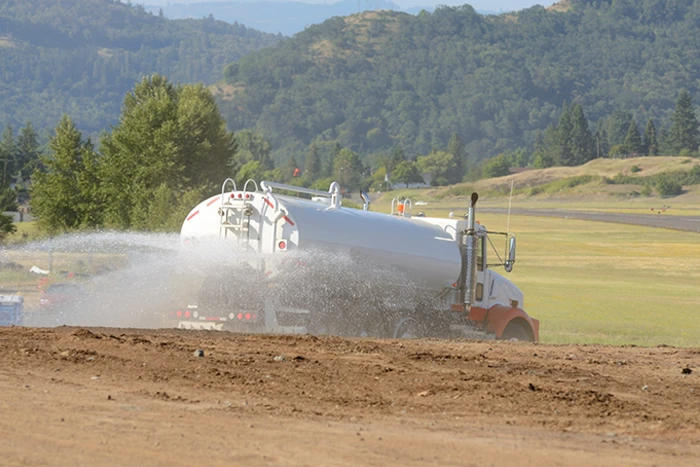
To avoid delays and fines and to protect surrounding communities, contractors should target common emission sources at their construction sites, including stockpiles of materials, blasting, earth-moving, and crushing activities. A fundamental best practice for preventing dust from becoming airborne is the regular application of water or approved chemical dust suppressants to unpaved roads, exposed soil, and material transfer points. Simultaneously, to mitigate DPM, contractors can implement administrative policies such as eliminating unnecessary vehicle idling, optimizing trucking routes, and restricting the total number of diesel-powered machines operating in a specific area.
At Environmental Risk Professionals (ERP), we offer risk mitigation services through Pollution Prevention Practices (PPPs). Our PPPs provide information on environmental exposures and mitigation tools to prevent the release of toxic or hazardous pollutants. ERP has Fugitive Dust Control, Construction Vehicle & Equipment Washing, Agriculture Dust Control, and Diesel Exhaust PPPs that provide guidelines for preventing and controlling particulate matter.
Construction is vital to a community's economic development by improving infrastructure, expanding housing, and creating job opportunities. However, this progress should not come at the expense of human health or environmental quality. By implementing Pollution Prevention Practices for dust control at construction and agricultural sites, the industry can protect communities, mitigate financial risk, and support sustainable long-term growth.

Authors

Josie Mudd
Environmental Scientist
Environmental Risk Professionals
About Author

Josie joined Environmental Risk Professionals as an Environmental Scientist in 2024. She has a Bachelor of Science degree in Sustainability from the College of Global Futures at Arizona State University.
In her role she assists with identifying environmental risks associated with various industries and generating documents aimed at helping companies understand the environmental risks associated with their operations. She also provides support for our CERC certification program, development of Operations and Maintenance (O&M) plans, and other risk-based services, as needed.