
Back to News
The Preventable Tragedy of Silicosis
When developing and implementing safety protocols for construction sites, the focus is often on the visible physical hazards, such as being hit by heavy, moving machinery or exposed electrical wires. We often overlook the invisible hazards or contaminants that pose a threat to both the workforce and the health of the surrounding communities. As an environmental scientist working in the consulting sector, I have observed a lack of education on exposure and risk mitigation for these invisible contaminants, specifically regarding the rising prevalence of crystalline silica.
Crystalline silica is a common mineral found in Earth's crust that can be found in many materials used at construction sites and manufacturing facilities, including stone, asphalt, sand, and brick. When high-powered tools are used on these materials, they release tiny particles known as respirable crystalline silica (RCS). When these particles are inhaled, they can lead to lung cancer, kidney disease, and chronic obstructive pulmonary disease. Most notably, exposure causes silicosis, a disease nicknamed “the king of occupational hazards”. Silicosis is a permanent, irreversible, and at times fatal disease that causes inflammation and scarring of the lungs.
Any trade that generates RCS, disturbs natural soils that may contain silica, or hauls silica-containing material is at risk of exposure. However, the increasing popularity of engineered stone countertops, which typically have a higher silica content than natural stone countertops, has led to a rise in silicosis cases within the stone countertop fabrication and installation industry.
The Massachusetts Department of Public Health issued a safety alert in November 2025 following the state's first confirmed case linked to the stone countertop industry. The California Department of Public Health also issued a health advisory notice in November, as it has become a hotspot for silicosis cases. Since 2019, there have been over 400 confirmed cases among countertop workers, including 25 deaths. The continued rise in silicosis cases is particularly alarming because we understand how RCS is generated, the health impacts it carries, and the ways to avoid this exposure. Even with this understanding and decades of research, the risk still has not been mitigated.
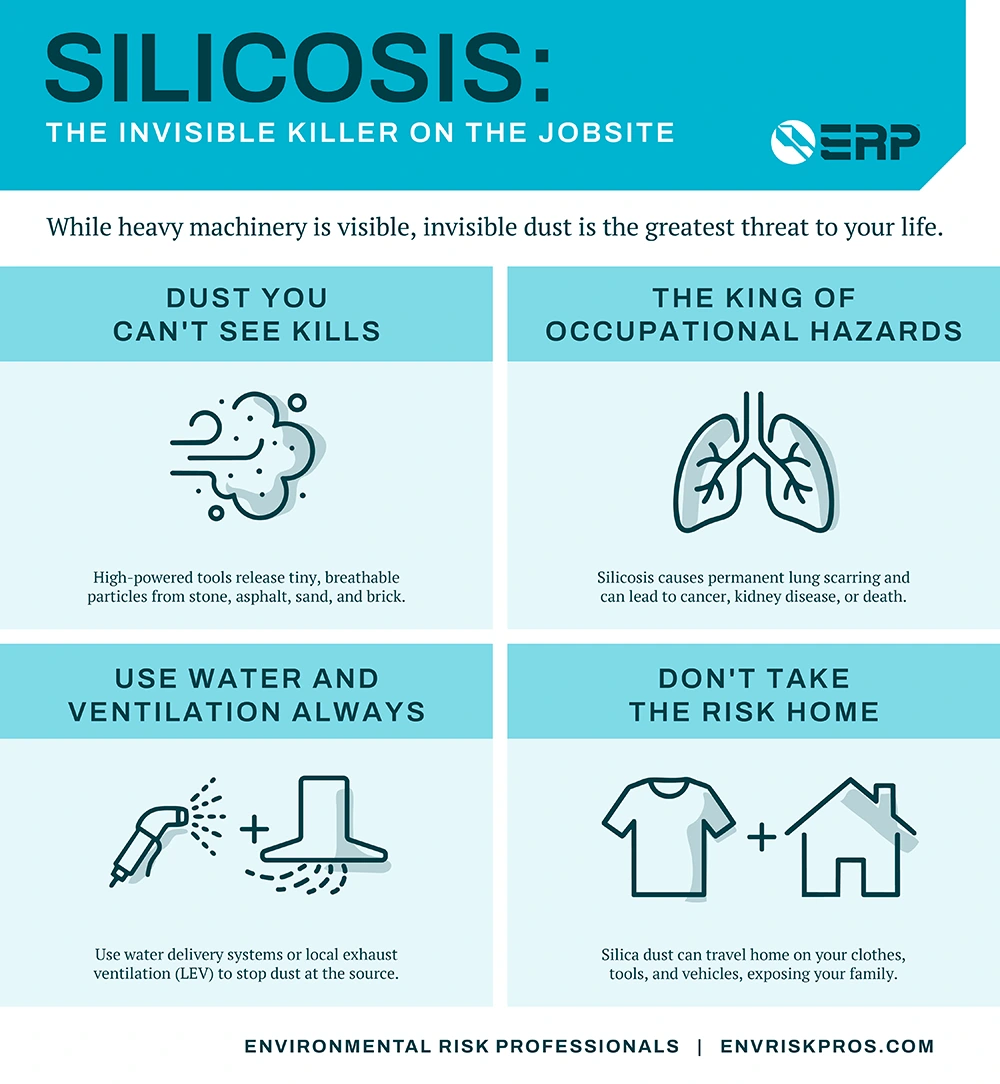
Several dust control methods are available to mitigate exposure to silica. The most effective, apart from elimination and substitution, is the use of engineering controls. Utilizing water delivery systems or attaching local exhaust ventilation (LEV) systems to power tools can significantly reduce exposure. Administrative controls can also be implemented, such as limiting exposure time, establishing housekeeping protocols, and developing a written exposure control plan.
Although it is nicknamed the king of occupational hazards, it is actually more than an occupational hazard; it is a community hazard. According to the Occupational Safety and Health Administration (OSHA), approximately 2.3 million people in the U.S. are exposed to silica. This figure accounts only for workers, excluding any third parties who may also be exposed to these particles. Third parties encompass a wide range of individuals who could be in the vicinity of construction or manufacturing activities, including maintenance and housekeeping staff, inspectors, emergency responders, and surrounding residents. Exposure can further extend into the home of employees if dust is carried back on clothes, tools, or vehicles.
When proper risk exposure and management education and protocols are implemented, worker and third-party exposure to RCS can be drastically reduced, thereby curbing the alarming rise in silicosis cases. Environmental Risk Professionals (ERP), an environmental consulting firm that provides risk mitigation services, offers Pollution Prevention Practices (PPPs), which provide information on environmental exposure and mitigation tools to prevent the release of toxic or hazardous pollutants. ERP’s Crystalline Silica PPP discusses best practices to protect employees and third parties from exposure to RCS. Ultimately, the choice between earning a living and maintaining one’s health is a choice no individual should be compelled to make.

Authors

Josie Mudd
Environmental Scientist
Environmental Risk Professionals
About Author

Josie joined Environmental Risk Professionals as an Environmental Scientist in 2024. She has a Bachelor of Science degree in Sustainability from the College of Global Futures at Arizona State University.
In her role she assists with identifying environmental risks associated with various industries and generating documents aimed at helping companies understand the environmental risks associated with their operations. She also provides support for our CERC certification program, development of Operations and Maintenance (O&M) plans, and other risk-based services, as needed.