
Back to News
We Don’t Care About Legionella Enough
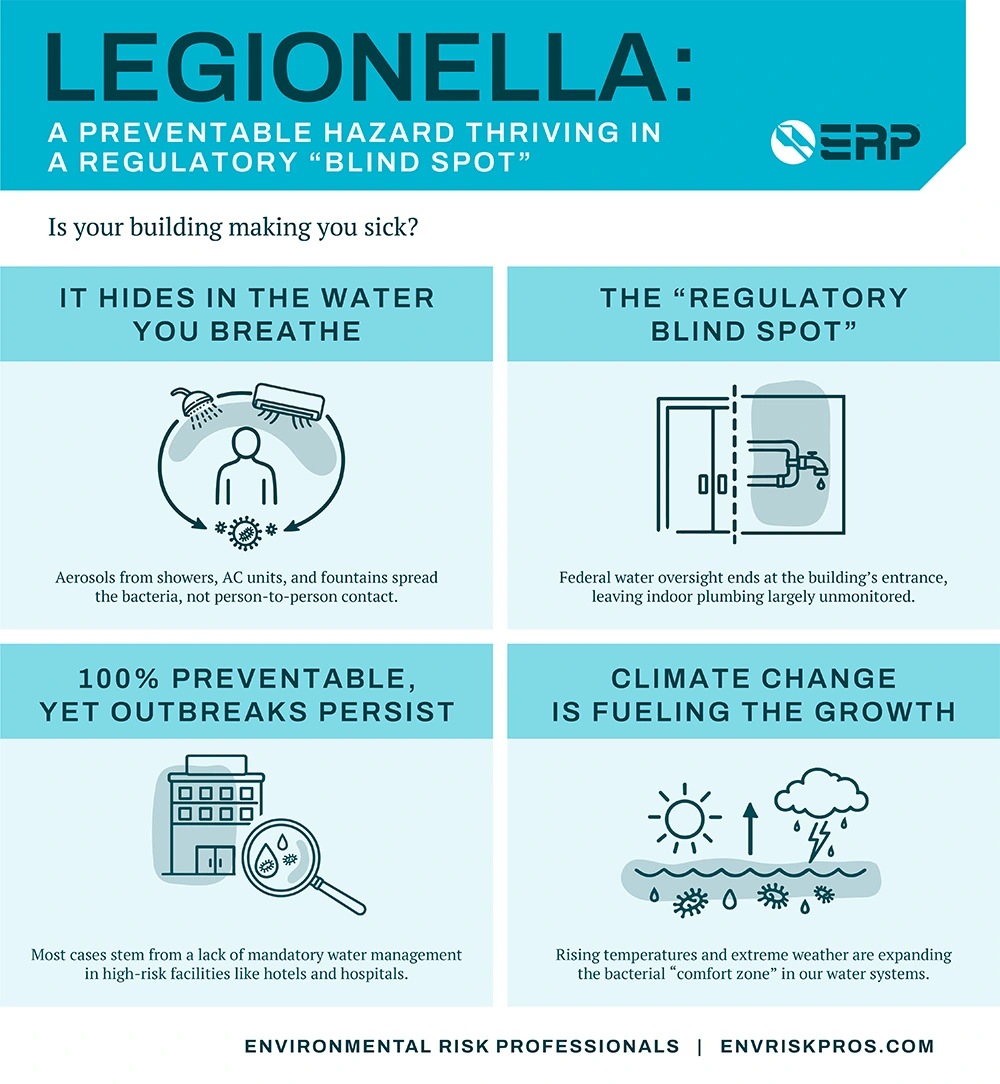
Air conditioners, fountains, jacuzzis, water dispensing systems, steam rooms, showers, and any other system where water can be aerosolized or accumulate and become stagnant are potential sources of Legionella. These create potential everyday health exposures from amenities we trust and use without a second thought.
The first case of Legionnaires' disease was recorded in 1976, after multiple people became sick at an American Legion Convention that took place at the Bellevue-Stratford Hotel in Philadelphia (Centers for Disease Control and Prevention, Legionella). Last week, news broke of at least 14 confirmed cases in Orange County, FL. Why, in nearly 50 years since the first reported outbreak of this preventable disease, are we still dealing with outbreaks today?
As an environmental scientist who assists companies with identifying environmental exposures, I ask that question with a mix of frustration and resignation. The science is not new. Legionella pneumophila is a bacterium that thrives in warm, stagnant water, particularly in man-made systems like cooling towers, hot water tanks, and plumbing systems (Centers for Disease Control and Prevention, Basic Information). We know that it spreads through inhalation of contaminated aerosols, not person to person. We know who is most at risk: older adults, smokers, people with chronic lung disease, or those with compromised immune systems (CDC, Legionella). And perhaps the most damning part of it all is that we know how to prevent it. Yet somehow, prevention remains on the back burner, used only reactively after unsuspecting, ordinary people get sick, and millions of dollars in claims have been filed.
Part of the problem is that Legionella lives in the cracks between our environmental and public health systems. At the federal level, the Environmental Protection Agency (EPA) regulates drinking water under the Safe Drinking Water Act. This law sets standards for contaminants, such as lead and arsenic, and microbial indicators, like E. coli, up until the point where water enters a building (Environmental Protection Agency; United States, Safe Drinking Water Act). Once water crosses that threshold, responsibility largely dissolves into a gray zone of building owners, facility managers, and local authorities. Legionella, which commonly occurs in plumbing and cooling systems, thrives in this regulatory blind spot (Environmental Protection Agency, Basic Information).
The CDC has been clear for years: most outbreaks are preventable with proper water management and consistent maintenance of at-risk systems. CDC guidance encourages building owners, especially those managing hospitals, nursing homes, hotels, and large residential complexes, to implement water management programs that monitor temperature, disinfectant levels, and stagnation (CDC, Developing a Water Management Program). But encouragement does not equal requirement. Outside of a handful of states, there are no enforceable mandates that say you must actively manage your building’s water system to prevent and monitor for Legionella. As far as I can tell, there is no cut-and-dry answer as to why this is. Mandating people to spend money on testing is often a hard ask in general, and it does not help that there is currently no definitive evidence-based consensus on the ideal frequency, location, or methods for routine testing, which can make broad mandates difficult to implement. If you prefer to be proactive instead of reactive and are struggling to find information on how to do so, contact a member of Environmental Risk Professionals to request access to a Pollution Prevention Plan specifically for Legionella.
All hope is not lost; some industry standards exist. ASHRAE Standard 188, first published in 2015 and most recently updated in 2021, outlines a framework for managing Legionella risk in buildings (ASHRAE). It is technically sound and widely referenced. But it is not law unless a state or local jurisdiction adopts it, which many have not. Some have partially, while others leave compliance entirely voluntary. In environmental health, voluntary compliance is often another way of saying “only after someone gets sick.”
Occupational safety regulations do not fill the gap either. The Occupational Safety and Health Administration (OSHA) recognizes Legionella as a hazard and has issued guidance, particularly for healthcare and industrial settings, but there are no specific, enforceable OSHA standards for Legionella exposure (Occupational Safety and Health Administration). Workers who maintain cooling towers, plumbing systems, or decorative water features are left dependent on employer diligence rather than regulatory certainty.
Some states have taken a patchwork approach. New York, spurred by a deadly outbreak in the Bronx in 2015, now requires registration, inspection, testing, and maintenance of cooling towers (New York State Department of Health). New Jersey mandates Legionella risk management plans for certain facilities (New Jersey Department of Health). These laws work because they move prevention upstream, before headlines, before hospitalizations, before funerals. But most states have not followed suit. In most of the country, Legionella prevention is still viewed as a best practice or a response to an outbreak, rather than a public duty.
Climate change is quietly exacerbating this risk. Warmer ambient temperatures extend the seasonal window in which Legionella can grow. Extreme weather events disrupt water systems, increase stagnation, and alter disinfectant chemistry (Environmental Protection Agency, Climate Change Indicators; CDC, Climate Change and Public Health). Energy efficiency measures, while essential, can inadvertently lower hot water temperatures into the bacterial “comfort zone” if not carefully managed (CDC, Developing a Water Management Program). Our built environment is changing faster than our regulations, and Legionella is exploiting that lag.
Outbreaks are still framed as unfortunate surprises. They should not be. When cases emerge from a hospital, a hotel, an apartment complex, or a correctional facility, we often react with shock, then we disinfect, test, and move on. But this cycle reveals our priorities. We invest heavily in treatment after exposure while underinvesting in prevention. We accept a certain number of illnesses as the cost of doing business, provided they are dispersed, sporadic, and largely invisible to those not directly affected.
If we really cared, water management would be treated with the same seriousness as fire safety or structural integrity. Building water systems would be routinely monitored for microbial risk. Federal guidance would be backed by enforceable standards. States would not wait for more outbreaks to justify action. And the public would understand that safe water does not end at the treatment plant—it ends at the tap, it extends to every pipe, tank, and tower we encounter daily.
Legionella has not outsmarted us. A world exists where it could be eradicated. We simply do not care enough about Legionella.

Authors

Elaina Long
Environmental Scientist
Environmental Risk Professionals
About Author

Elaina joined Environmental Risk Professionals as an Environmental Scientist in 2024. She has Bachelors of Arts degree in Environmental Science and Sustainability from Northern Arizona University.
In her role she assists with identifying environmental risks associated with various industries and generating documents aimed at helping companies understand the environmental risks associated with their operations. She also provides support for our CERC certification program, development of Operations and Maintenance (O&M) plans, and other risk-based services, as needed.